
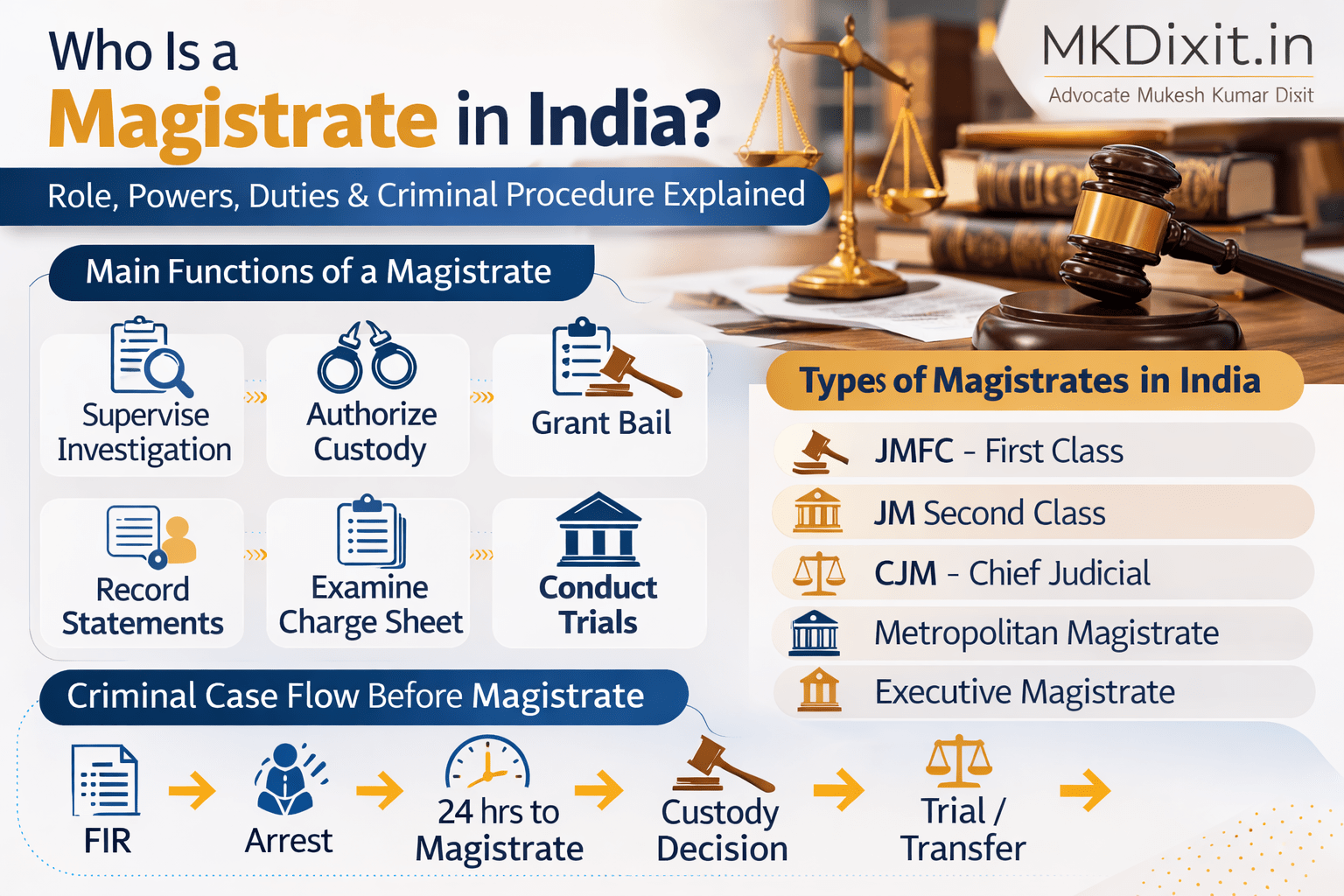
A Magistrate is a judicial officer who handles criminal cases at the first level of courts in India.
Magistrates supervise police investigation, authorize custody, hear bail applications, record statements, and conduct trials for many criminal offences.
Most criminal cases first appear before a Magistrate before moving to higher courts like Sessions Court. Decisions taken at this early stage often shape the direction and legality of the entire case.
This guide explains in practical terms:
- Who a Magistrate is
- Types of Magistrates in India
- Powers and responsibilities
- Role during investigation stage
- Role during trial stages
- Custody and remand control
- Citizen rights before Magistrate
- Local court practice
- Practical considerations
- FAQs and procedural clarity
The aim is to provide citizens, litigants, interns, and law students with procedural understanding rather than legal jargon.
Table of Contents
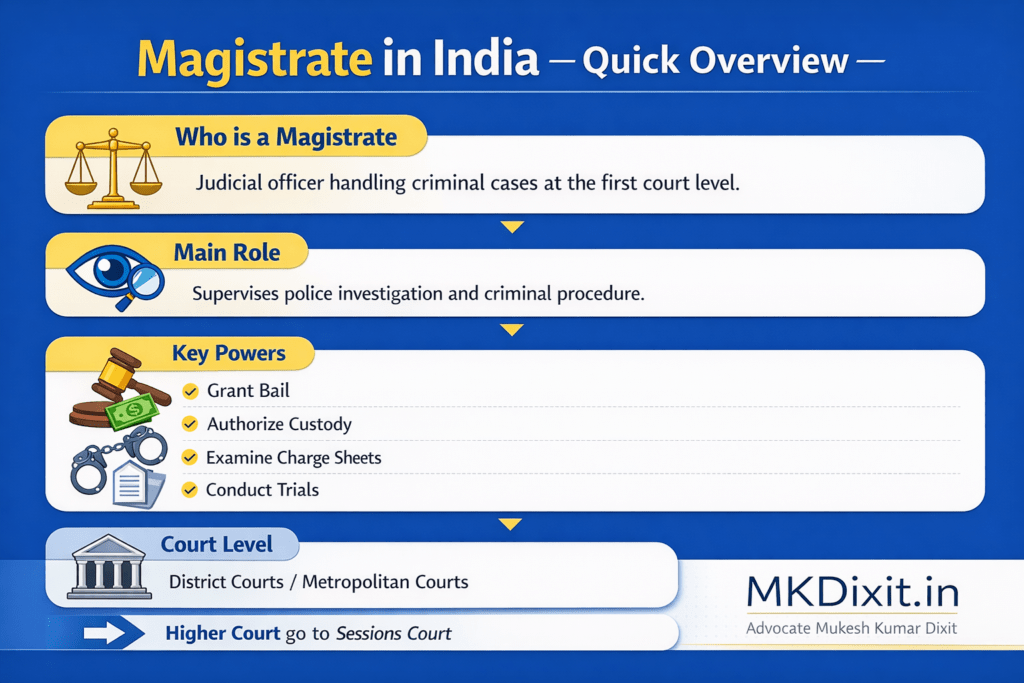
Magistrate in India – Quick Overview
| Aspect | Explanation |
|---|---|
| Who is a Magistrate | A judicial officer handling criminal cases at the first court level |
| Main role | Supervising police investigation and criminal procedure |
| Key powers | Bail decisions, custody authorization, trial of certain offences |
| Court level | District courts and metropolitan courts |
| Higher court | Serious cases go to Sessions Court |
What Is a Magistrate? (Simple Meaning)
A Magistrate is a judicial officer appointed to handle criminal matters at the initial court level. Magistrates function under procedural law and supervise criminal cases at early and intermediate stages. A Magistrate is a judge who deals with criminal cases at the lowest level of the court system in India.
Magistrates handle:
- conducting trials for many criminal offences
- arrest and custody decisions
- bail hearings
- recording statements
- reviewing police investigations
They ensure:
- Police action remains lawful,
- Accused rights are protected,
- Proper procedure is followed,
- Investigations proceed legally,
- Charges are processed correctly.
Most criminal cases begin before a Magistrate before moving to Sessions Court when required.
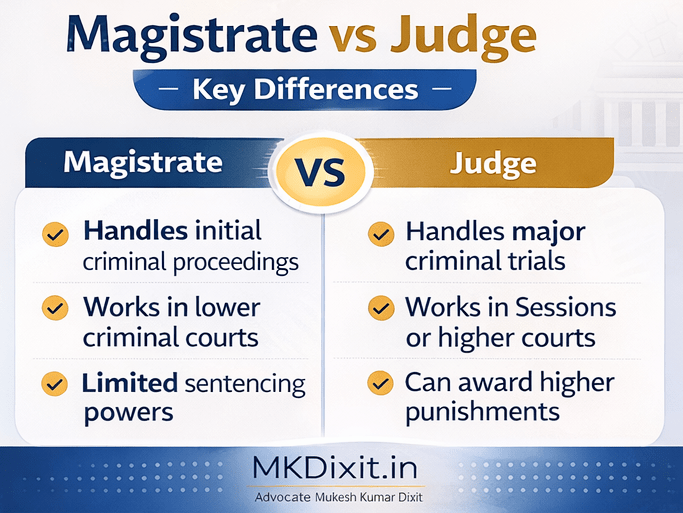
Difference Between Magistrate and Judge
| Magistrate | Judge |
|---|---|
| Handles lower-level criminal cases | Handles higher courts like Sessions Court |
| Limited sentencing powers | Can award higher punishments |
| Supervises investigation stage | Conducts major trials |
| First stage of criminal justice | Later stage of trial |
What Does a Magistrate Do?
A Magistrate performs several important functions in the criminal justice system. Their primary responsibility is to ensure that police investigations and criminal proceedings follow legal procedure.
Major duties of a Magistrate include:
- reviewing arrests made by police
- authorizing police custody or judicial custody
- hearing bail applications
- recording confessions and witness statements
- examining police charge sheets
- conducting trials for certain criminal offences
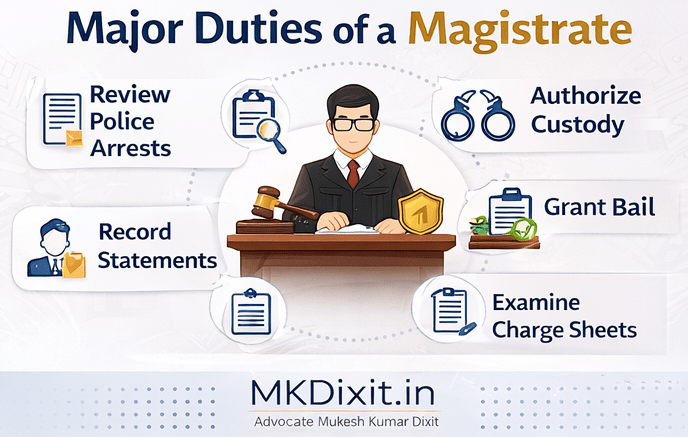
Through these powers, Magistrates act as the first judicial authority protecting the rights of both accused persons and victims.
Types of Magistrates in India
Criminal courts operate with different categories of Magistrates depending on seriousness of offences.
Magistrate Classification Table
| Type of Magistrate | Role | Powers |
|---|---|---|
| Judicial Magistrate First Class (JMFC) | Handles regular criminal cases | Can try offences with moderate punishment |
| Judicial Magistrate Second Class | Handles minor cases | Limited sentencing powers |
| Chief Judicial Magistrate (CJM) | Supervises Magistrates | Greater sentencing authority |
| Metropolitan Magistrate | Functions in metropolitan cities | Similar powers to JMFC |
| Executive Magistrate | Administrative functions | Preventive and law-and-order powers |
Most citizens encounter Judicial or Metropolitan Magistrates.
What Is an Ilaqa Magistrate?
An Ilaqa Magistrate refers to the Magistrate who has jurisdiction over a particular police station area or locality. Criminal cases registered within that police station are generally presented before the Magistrate assigned to that jurisdiction.
Why Magistrate Is Crucial in Criminal Proceedings
The Magistrate acts as the first judicial checkpoint after police action. This ensures police powers are not exercised arbitrarily.
The Magistrate:
- Reviews arrests,
- Approves custody,
- Examines charges,
- Records statements,
- Supervises investigation progress,
- Commences trial process.
Without Magistrate oversight, investigation and detention could become unlawful.
Stage-Wise Role of Magistrate in Criminal Proceedings
1. After FIR Registration
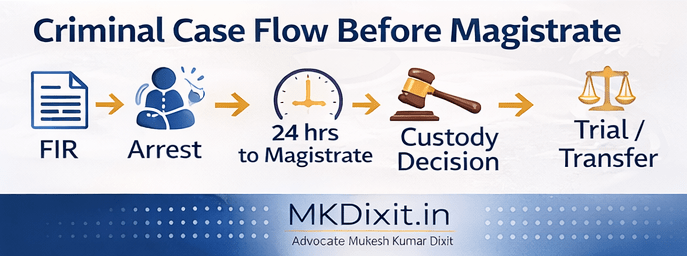
Once police register an FIR and arrest a suspect, the accused must be produced before a Magistrate within 24 hours.
Magistrate examines:
- Legality of arrest,
- Grounds of detention,
- Need for further custody,
- Rights of accused.
Police cannot detain someone beyond 24 hours without Magistrate approval.
2. Custody and Remand Control
One of the most critical Magistrate functions is deciding custody.
Custody Types Explained
| Custody Type | Control Authority | Meaning |
|---|---|---|
| Police Custody | Police control | Used for interrogation |
| Judicial Custody | Jail authority | Accused kept in prison |
| Bail Release | Court order | Accused released with conditions |
Magistrate decides whether police custody is necessary or judicial custody is sufficient.
3. Recording Statements and Evidence
Magistrates may record:
- Confessions,
- Witness statements,
- Victim statements in sensitive offences.
These statements become important evidence later.
The Magistrate must ensure statements are voluntary and not forced.
4. Bail Hearings
In bailable offences, Magistrates grant bail as a right. In non-bailable offences, bail decisions depend on case facts.
Magistrate evaluates:
- Seriousness of offence,
- Possibility of absconding,
- Evidence status,
- Risk to witnesses,
- Cooperation of accused.
Bail orders protect personal liberty while allowing investigation.
5. Filing of Charge Sheet
After investigation, police submit charge sheet before Magistrate.
Magistrate examines:
- Completeness of investigation,
- Supporting evidence,
- Legal sections applied,
- Procedural correctness.
If adequate material exists, Magistrate takes cognizance of offence.
6. Beginning Trial Proceedings
For less serious offences, Magistrates conduct trials themselves. For serious crimes, the case is transferred to Sessions Court.
Magistrate handles:
- Supply of documents,
- Framing of charges,
- Initial hearings,
- Committal to higher court.
Thus, trial structure begins under Magistrate supervision.
Offences Magistrate Can Try
Magistrates generally try offences with moderate punishment limits.
Serious crimes like murder or rape are sent to Sessions Courts after preliminary proceedings.
Practical Workflow: Magistrate’s Role in Case Progress
Criminal Case Flow
| Stage | Magistrate’s Role |
|---|---|
| FIR registered | Receives case papers |
| Arrest made | Reviews legality |
| Accused produced | Decides custody |
| Investigation continues | Supervises legality |
| Charge sheet filed | Takes cognizance |
| Charges framed | Begins proceedings |
| Case transferred or tried | Trial progresses |
Magistrate involvement spans multiple procedural checkpoints.
Rights of Citizens Before Magistrate
Citizens appearing before Magistrate possess legal protections.
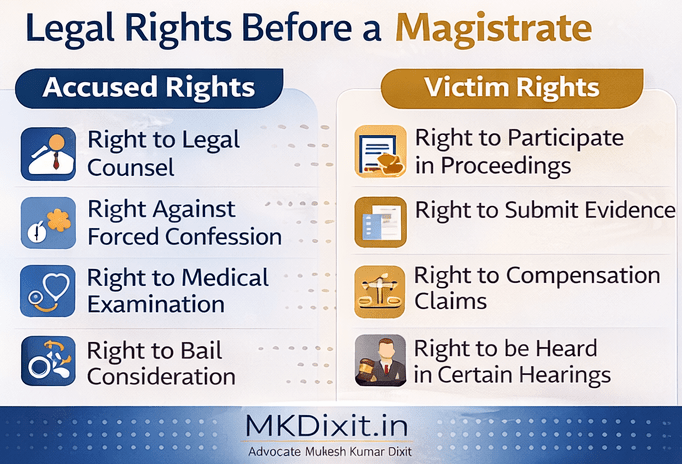
Accused Rights
- Right to legal counsel
- Right against forced confession
- Right to medical examination
- Right to bail consideration
- Right to fair procedure
Victim Rights
- Right to participate in proceedings
- Right to submit evidence
- Right to compensation claims
- Right to be heard in certain hearings
Magistrate ensures balance between investigation and rights.
Magistrate’s Role in Preventive Action
Magistrates also exercise preventive powers to maintain public order.
They may:
- Issue orders to prevent violence,
- Direct removal of public nuisance,
- Impose temporary restrictions,
- Bind individuals to maintain peace.
These measures prevent crimes before they occur.
Common Misunderstandings About Magistrates
Many people assume Magistrates only conduct trials, but their role is wider.
Common myths include:
| Myth | Reality |
|---|---|
| Magistrates only sign papers | They supervise legality |
| Police decide custody | Magistrate authorizes custody |
| Bail is automatic | Magistrate evaluates facts |
| Trial starts directly in Sessions Court | Magistrate handles initial stage |
Understanding actual functions helps citizens navigate procedure better.
Magistrate Courts and Local Practice
In districts such as Ghaziabad, Magistrate courts handle a large volume of criminal matters daily. Digital filing, case management systems, and standardized procedures have improved efficiency, though delays still occur due to heavy caseloads.
Local courts follow national criminal procedure but administrative practices may differ slightly depending on workload and infrastructure.
Role of Advocates Before Magistrate
Advocates assist parties in presenting applications, arguments, and procedural requests.
A practicing advocate, such as Advocate Mukesh Kumar Dixit of MK Dixit Law Chambers, typically assists clients in:
- Bail applications,
- Remand objections,
- Drafting complaints,
- Filing applications,
- Presenting legal arguments.
The advocate’s role remains procedural and advisory without guaranteeing outcomes.
Practical Considerations for Litigants
People often face confusion at Magistrate level due to procedural unfamiliarity.
Common practical advice:
- Carry identity documents.
- Attend court on time.
- Follow advocate instructions.
- Keep copies of all filings.
- Maintain respectful conduct in court.
Procedural compliance avoids unnecessary delay.
Challenges Faced by Magistrate Courts
Despite procedural safeguards, courts face challenges:
- Heavy case load,
- Investigation delays,
- Frequent adjournments,
- Infrastructure limitations,
- Witness non-appearance.
Judicial reforms continue aiming to improve efficiency.
Importance of Magistrate Oversight in Justice System
The Magistrate’s role protects citizens from arbitrary detention while allowing lawful investigation. Without judicial supervision, police powers could lead to rights violations.
Thus, Magistrate courts function as guardians of procedural justice.
Conclusion
Magistrates form the backbone of India’s criminal court system, ensuring criminal cases proceed lawfully from investigation to trial. From custody authorization to charge examination and trial commencement, their decisions impact the fairness and legality of proceedings.
Understanding this role helps citizens engage confidently with the justice system, protect their rights, and follow proper legal procedure when facing criminal litigation.
Frequently Asked Questions About Magistrates in India
1. Is every accused produced before Magistrate?
Yes, within 24 hours of arrest.
2. Can Magistrate grant bail?
Yes. Magistrates can grant bail in many criminal cases depending on the nature of the offence and legal provisions. In bailable offences bail is granted as a right, while in non-bailable offences the Magistrate evaluates the seriousness of the offence, available evidence, and risk of absconding.
3. Does Magistrate conduct all trials?
Only less serious offences; major crimes go to Sessions Court.
4. Can Magistrate reject police custody?
Yes, if custody is unnecessary.
5. Does Magistrate supervise investigation?
Procedurally, yes.
6. Can Magistrate record confession?
Yes, if voluntary.
7. What happens after charge sheet filing?
Magistrate begins court proceedings or transfers case.
8. Can citizens approach Magistrate if police refuse action?
Yes, legal remedies exist through court applications.
9. What is a Duty Magistrate?
A Duty Magistrate is a Magistrate assigned to handle urgent court matters outside regular court hours. They review arrests, custody requests, and emergency applications to ensure legal procedures are followed even during holidays or late hours.
10. What is a Judicial Magistrate?
A Judicial Magistrate is a judicial officer who handles criminal cases under the criminal procedure law. They conduct trials, grant bail, examine evidence, and supervise criminal investigations.
11. What is JMFC Court?
JMFC stands for Judicial Magistrate First Class Court. These courts handle many criminal cases involving offences with moderate punishments and conduct trials at the district level.
12. What is the difference between a Magistrate and a Judge?
A Magistrate handles the early stages of criminal cases and minor criminal trials. A Judge, particularly a Sessions Judge, conducts trials for serious offences such as murder, rape, and major criminal matters.
13. What are the powers of a Magistrate?
Magistrates have powers to:
- grant bail
- authorize custody
- issue warrants
- record statements
- supervise investigations
- conduct trials for certain offences
14. Can police act without Magistrate permission?
Police may arrest in certain situations, but the accused must be produced before a Magistrate within 24 hours, who decides whether detention can continue.
15. What is the meaning of Magistrate?
The term “Magistrate” refers to a judicial officer who exercises limited court powers to handle criminal cases at the lower level of the judiciary. Magistrates supervise police investigations, decide custody and bail matters, and conduct trials for certain offences according to criminal procedure law.
16. What is Magistrate Court?
A Magistrate Court is a lower criminal court where most criminal cases begin. These courts deal with arrests, bail applications, police investigations, and trials of less serious offences before cases are transferred to higher courts if necessary.
17. Who appoints Magistrates in India?
Judicial Magistrates are appointed through state judicial service examinations conducted under the supervision of the High Courts. Candidates selected through these exams join the subordinate judiciary and are later posted as Judicial Magistrates in district courts.
Related Resources
- FIR Filing Guide
- Arrest Procedure Explained
- Bail Procedure in India
- Criminal Trial Procedure Guide
- Practice Areas Page
- About Advocate Page
Assistance Note
Individuals seeking procedural clarity in criminal matters may consult a qualified legal practitioner for guidance tailored to their situation.
Leave a Reply